
Key facts
- MPC stands for multi-party computation, a branch of cryptography developed from the 1980s onwards.
- An MPC wallet splits signing power into key shares held by separate parties or devices.
- The full private key is never assembled, not even while a transaction is signed.
- The blockchain sees one standard signature, so MPC works on most major blockchains.
- MPC wallets don't need a seed phrase.
How Does an MPC Wallet Work?
A normal blockchain wallet is controlled by one private key. Whoever holds that key, or the seed phrase that recreates it, controls the assets.
An MPC wallet replaces that single key with key shares:
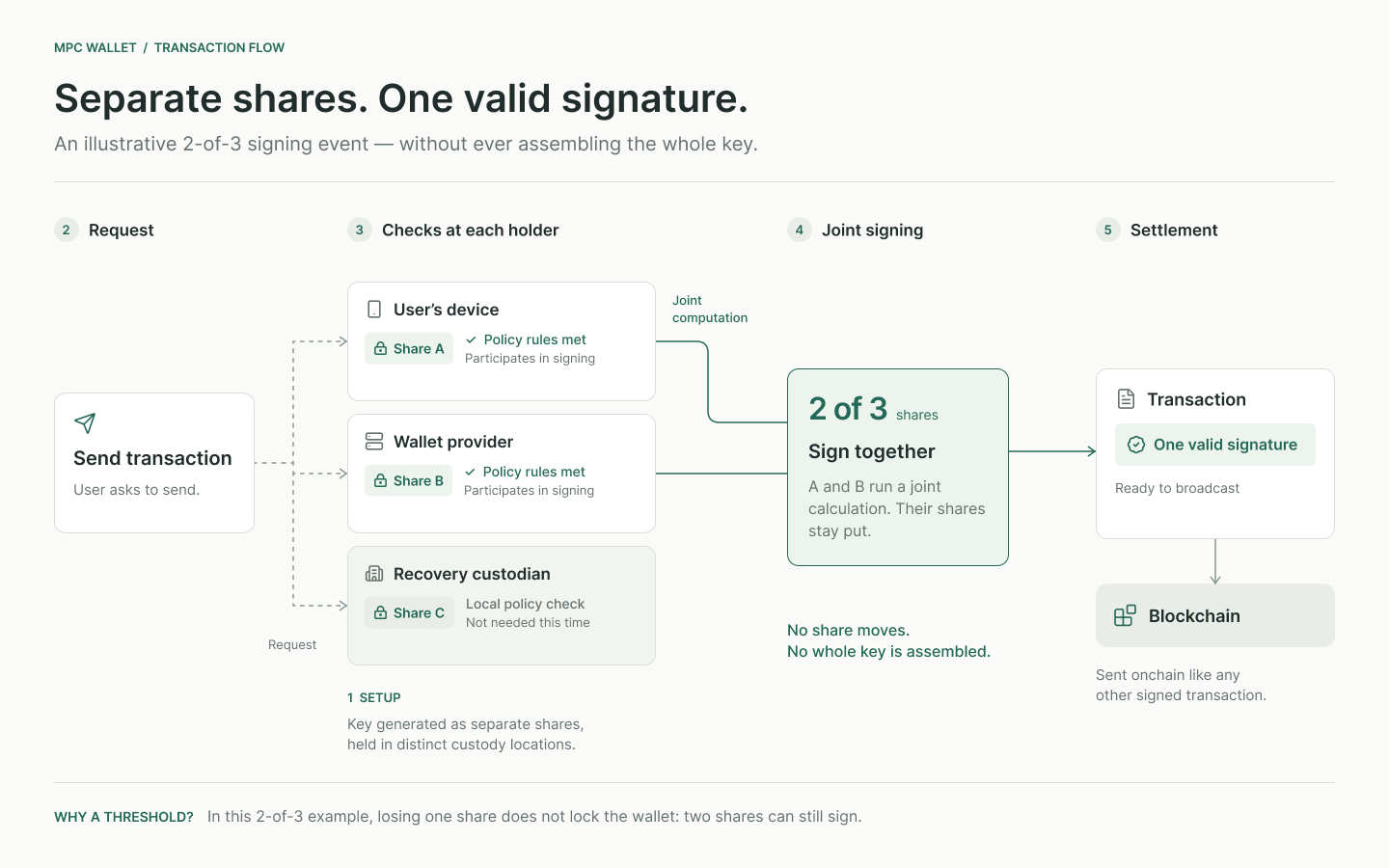
- Setup. The wallet's key is generated as separate shares, held by different parties or machines. The whole key never exists in one place.
- Request. A user asks to send a transaction.
- Checks. Each party holding a share checks the request against the rules set for that wallet.
- Signing. If the rules are met, the parties run a joint calculation that produces a valid signature. Each share stays where it is.
- Settlement. The signed transaction goes to the blockchain like any other.
Most MPC wallets use a threshold: for example, 2 of 3 shares must take part to sign. That way, losing one share doesn't lock the wallet.
Is MPC Safer Than a Seed Phrase?
MPC removes the single point of failure. With a seed phrase, anyone who finds those 12 or 24 words can take everything, and anyone who loses them may lose access for good. With MPC, a thief would need to compromise several separate parties at once, and there are no words to lose.
How safe an MPC wallet is in practice depends on how it is built: where the shares are held, who runs each one and what rules they enforce.
What's the Difference Between MPC and Multisig?
Both spread control across more than one party. Multisig does it onchain: the blockchain checks several separate signatures, and each blockchain handles multisig differently. MPC does it before anything reaches the chain: the parties produce one ordinary signature, so the same setup works across blockchains and transactions look like any other. We cover this in detail in MPC vs Multisig.
Who Uses MPC Wallets?
Institutions such as funds, banks and fintech platforms use MPC to control digital assets without relying on one person or one device. It lets them set approval rules (who can send, how much and to whom) and enforce them at the point of signing. More consumer wallets now use MPC too, because it removes the seed phrase.
FAQ
- What does MPC stand for?
- Multi-party computation.
- Does an MPC wallet have a private key?
- Yes, but it only ever exists as separate shares. It is never put together in one place.
- Can the company running an MPC wallet move my assets?
- It depends on the design. In NAVRA, no single party, including NAVRA, holds enough shares to sign alone.
- Do MPC wallets work on every blockchain?
- They work on most major blockchains, because the chain only sees a standard signature.
- Do I need a seed phrase with an MPC wallet?
- No. Access is protected by the key shares and the wallet's approval rules, not by a list of words.